
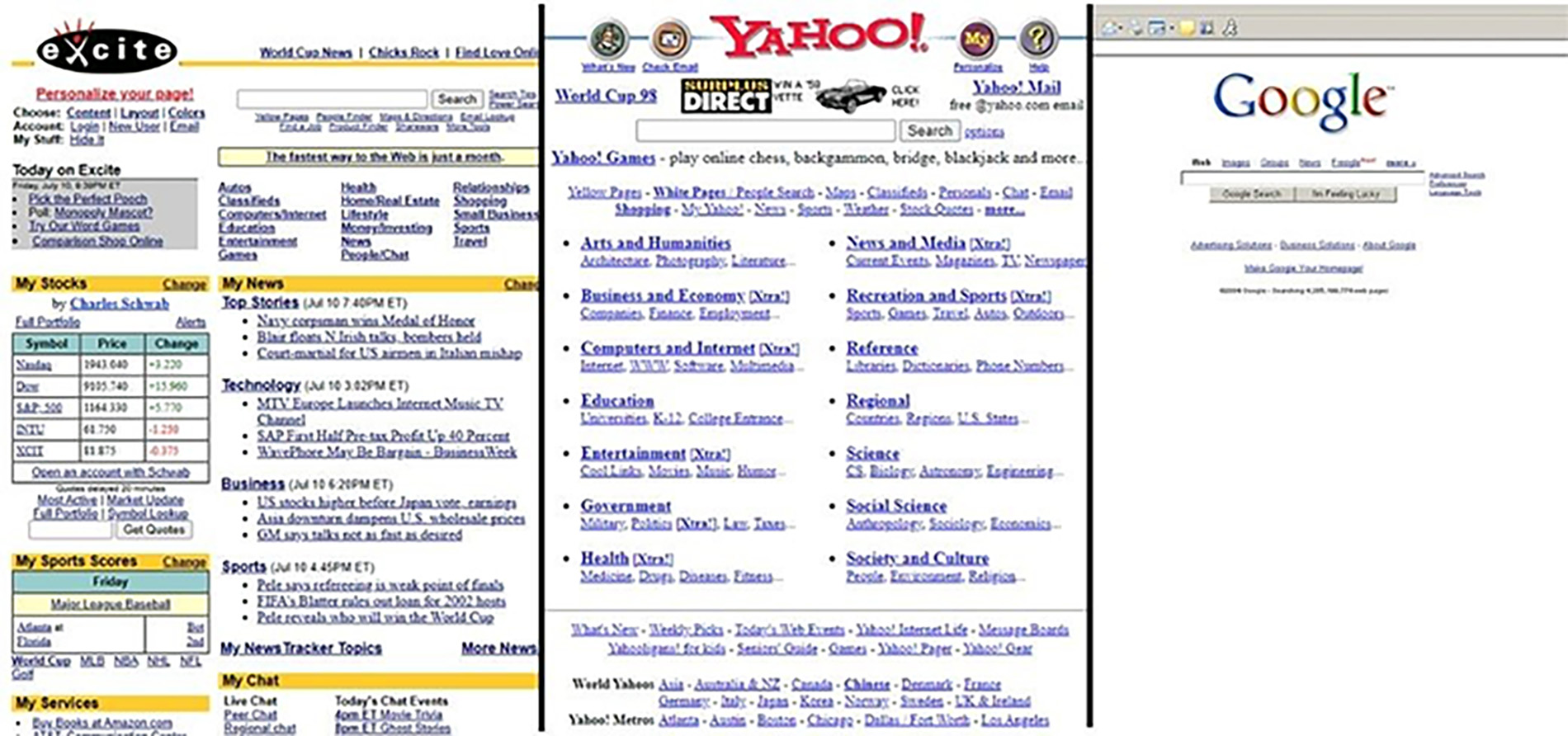
In the late 1990s, the internet was a vibrant, chaotic frontier. Portals like Yahoo, AOL, and Excite were the undisputed kings, serving as the primary gateways to the web for millions. Their strategy was clear: be a one-stop shop for everything. They offered email, news, stock quotes, games, and horoscopes—all designed to keep you on their site for as long as possible. Search was just another feature, often cluttered and secondary. Then, a newcomer arrived with a radically different idea. That newcomer was Google, and its search dominance strategy of doing one thing exceptionally well would change the internet forever.
This article explores how Google’s laser focus on search allowed it to dominate a crowded market. Understanding Google’s search dominance strategy sheds light on the “more is more” approach of its competitors and draws a direct line to the feature-packed, app-heavy world of our modern smartphones. Looking back, we can understand the risks of digital clutter today and speculate on whether simplicity could be the next significant disruption.
Google’s Unwavering Focus on Search
When Google launched in 1998, its homepage was a stark contrast to the busy portals of the era. It was clean, almost empty, featuring little more than a logo and a search bar. This minimalist design was a direct reflection of its mission: to organize the world’s information and make it universally accessible and useful. For founders Larry Page and Sergey Brin, the goal wasn’t to keep users on their site; it was to get them to the information needed as quickly as possible, aligning perfectly with Google’s search dominance strategy.
The magic behind this was PageRank, a revolutionary algorithm that ranked web pages based on the number and quality of links pointing to them. PageRank was a massive leap forward from other search engines, which often relied on simple keyword matching and were easily manipulated. Google delivered more relevant, accurate, and trustworthy results.
This dedication to search excellence was a gamble. Instead of trying to build a walled garden of content and services, Google bet that a superior search experience alone would be enough to win over users. Google trusted that people would return not because they were forced to, but because it was the best tool for the job. The strategy worked, and users flocked to Google, drawn by its speed, simplicity, and effectiveness.
The Portal Problem: A Jack of All Trades
While Google was refining its search algorithm, its competitors were heading in the opposite direction. Yahoo, AOL, Lycos, and Excite were rapidly expanding their offerings. Their homepages became a dizzying array of widgets and links, pushing horoscopes, chat rooms, news headlines, and shopping deals. Their business model depended on “stickiness”—keeping users engaged with their proprietary content to maximize ad revenue.
Search was an essential part of their service, but it was just one piece of a much larger puzzle. It was often relegated to a small box surrounded by countless other distractions. The quality of the search results themselves became a secondary concern. As these portals grew more bloated with features, their core search function stagnated.
By trying to be everything to everyone, they failed to be the best at the one thing users needed most: finding information. They viewed the internet as a destination they owned, while Google saw it as a path to other destinations. This fundamental difference in philosophy ultimately led to the downfall of the portal model and to Google’s search dominance strategy being recognized as superior.
The Modern Parallel: App Overload on Your Phone
Fast forward to today, and we see a similar pattern playing out in the palms of our hands. Our smartphones have become the new digital portals, and apps are the features. Each app promises to solve a problem, entertain us, or make our lives easier. We have separate apps for banking, messaging, social media, fitness, food delivery, and dozens of other tasks.
App developers, much like the portals of the 90s, are locked in a battle for our attention. They push a constant stream of notifications and add new features to increase engagement and “stickiness.” This has led to “feature bloat,” where simple apps become complicated and confusing. A simple photo-sharing app now has stories, reels, a marketplace, and direct messaging. The core function gets lost in a sea of additions.
This ecosystem encourages us to download more and more apps, cluttering our screens and our minds. Just as users in 1999 had to navigate a chaotic Yahoo homepage to find the search bar, we now scroll through pages of app icons to find the one tool we need. The convenience of having a dedicated app for everything is starting to give way to the burden of managing them all.
Security and Privacy: The Hidden Cost of Digital Clutter
This proliferation of apps comes with significant risks that go beyond simple inconvenience. Every app installed on your phone is a potential gateway for security breaches and privacy invasions. Each one requires a set of permissions, often requesting access to your contacts, camera, microphone, and location data.
Managing these permissions across dozens or even hundreds of apps is a nearly impossible task for the average user. A single compromised app can expose your personal information, financial details, and private conversations. Furthermore, many apps collect vast amounts of data for advertising purposes, tracking your behavior across the digital and physical world. The more apps you have, the larger your digital footprint and the greater your exposure to data leaks and misuse. This complex web of apps creates a fragile ecosystem where one weak link can compromise your entire digital life.
The Future of Simplicity: A Return to Essentials?
Could the solution to this complexity be a return to radical simplicity? Just as Google offered a clean alternative to cluttered portals, it’s possible a company could find success with a streamlined smartphone. Imagine a device that focuses only on the essential functions: calling, texting, a high-quality camera, maps, and a secure browser. It would be free of app stores, social media notifications, and data-hungry software.
This idea is already gaining traction with the “dumbphone” or “feature phone” revival, especially among those seeking a digital detox. However, a genuinely modern, minimalist phone would not sacrifice quality. It would combine premium hardware and sophisticated, privacy-focused software to deliver an elegant, distraction-free experience.
Such a device would echo the promise Google first made: to be a tool that serves the user, not a platform that captures them. It would be for people who want technology to help them engage with the world, not distract them from it. Google’s search dominance strategy was about offering less to achieve more. While it may seem like a niche market now, the growing fatigue with digital overload could make a simple, secure, and beautiful phone the next major disruption.
The Enduring Lesson from Google’s Rise
The story of Google’s ascent is more than just tech history; it’s a powerful lesson in the value of focus and simplicity. By resisting the temptation to be everything to everyone, Google provided a tool that did one thing perfectly. It solved a fundamental user need with elegance and efficiency, earning the loyalty of millions.
Today, as we navigate a digital world that feels increasingly cluttered and demanding, that lesson is more relevant than ever. The overwhelming complexity of our mobile app ecosystem presents an opportunity for a new wave of innovation—one that prioritizes user well-being, security, and peace of mind over constant engagement. Whether it’s a simplified smartphone or a new generation of focused software, the future may belong to those who, like Google in 1998, have the courage to offer less.
Quick Web Designs’ skilled marketing experts stay current with the latest industry trends. Our precise techniques and innovative strategies will help you meet your business goals. Contact us today for a free consultation.